Client-Side Concerns and Infrastructure
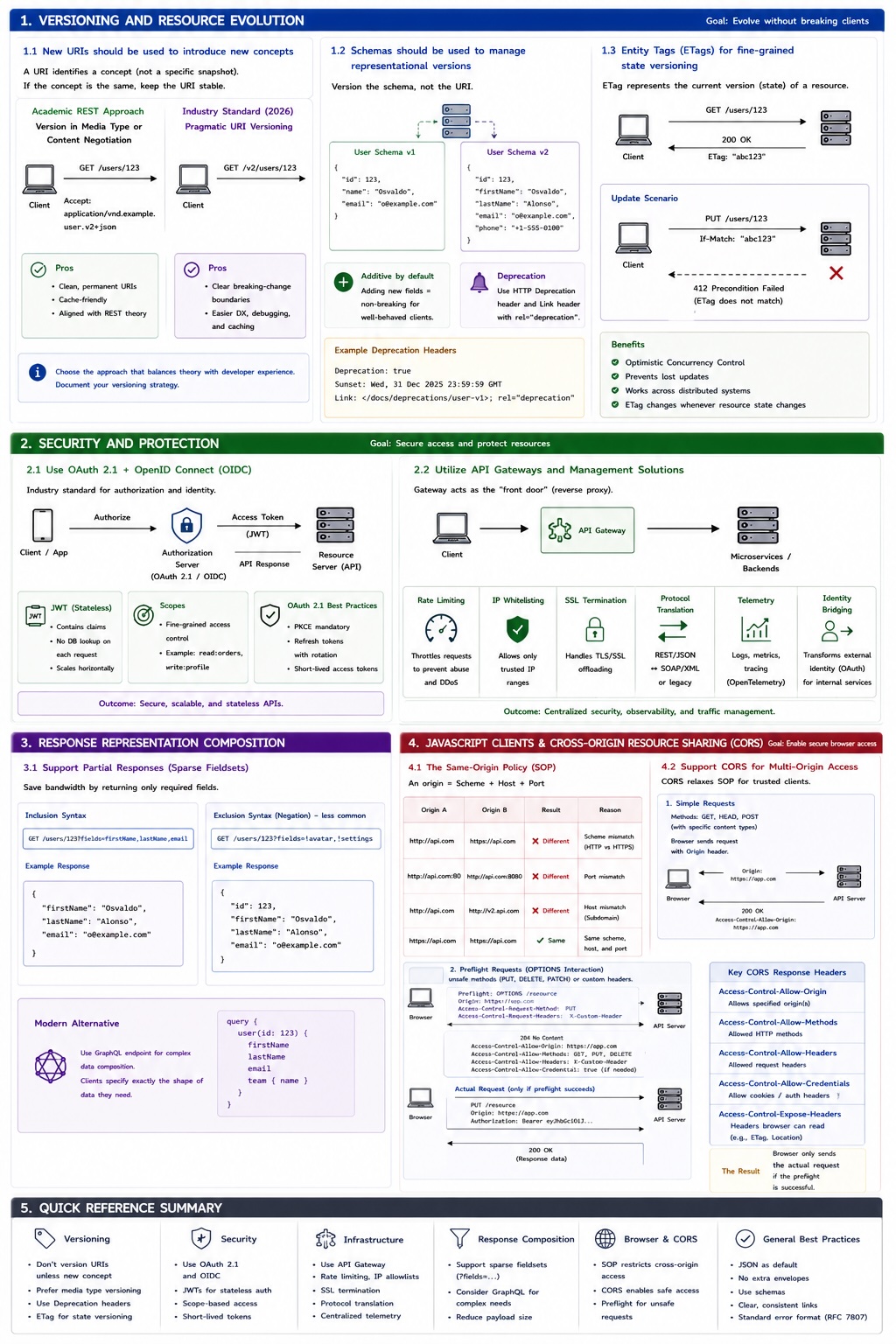
A REST API's design must account for the diverse needs of its clients—ranging from bandwidth conservation on mobile devices to the security restrictions of browser-based JavaScript environments.
1. Versioning and Resource Evolution
In RESTful theory, a URI identifies a concept, not a specific snapshot of data. Effectively managing changes without breaking clients is a hallmark of a mature API. While many developers default to putting version numbers in the URI, this can lead to "URI bloat."
Rule: New URIs should be used to introduce new concepts
A URI identifies a resource that remains conceptually constant over time. If a "User" resource evolves from having a name field to having firstName and lastName, the concept of "User" hasn't changed—only its representation has.
- Academic REST Approach: Versioning should happen in the Media Type or via Content Negotiation (e.g.,
Accept: application/vnd.example.v2+json). This keeps the URI clean and permanent. - Industry Pragmatism (2026 Standard): While URI versioning (e.g.,
/v1/users) is technically "un-RESTful," it is the industry standard for developer experience (DX). It provides clear, breaking-change boundaries that are easy to debug and cache.
Rule: Schemas should be used to manage representational versions
Instead of changing the URI, version the schema.
- Forward Compatibility: Design APIs to be additive. Adding a new field to a JSON response is generally not a breaking change for well-behaved clients.
- Deprecation: Use the
DeprecationandLink(withrel="deprecation") HTTP headers to inform clients that a specific representation version is nearing end-of-life.
Rule: Entity Tags (ETags) for fine-grained state versioning
ETag values act as a versioning system for the state of an individual resource.
- Use
ETagto implement Optimistic Concurrency Control. A client sendsIf-Match: "etag_value"with aPUTrequest to ensure they aren't overwriting a version of the resource they haven't seen.
2. Security and Protection
Rule: Use OAuth 2.1 for Resource Protection
OAuth is the industry-standard authorization framework. In 2026, OAuth 2.1 has consolidated best practices (like mandatory PKCE for all clients) and OpenID Connect (OIDC) (the identity layer) are the defaults.
- Statelessness: REST APIs should utilize JWTs (JSON Web Tokens) for authorization. This allows the API to remain stateless, as the token contains all the necessary claims (identity and scopes) to authorize the request without a database lookup on every call.
- Scope-based Access: Protect resources by defining granular scopes (e.g.,
read:orders,write:profile).
Rule: Utilize API Gateways and Management Solutions
Modern infrastructure utilizes an API Gateway (a specialized reverse proxy) as a "front door."
-
Responsibilities: The gateway handles cross-cutting concerns: Rate Limiting (preventing DDoS), IP Whitelisting, SSL Termination, and Telemetry.
- Rate Limiting: Protecting the API from "thundering herd" issues or DDoS attacks.
- Protocol Translation: Converting modern requests (REST/JSON) to legacy backends (SOAP/XML).
- Telemetry: Centralized logging, metrics, and tracing (OpenTelemetry).
-
Identity Bridging: Gateways can translate external OAuth tokens into internal identifiers for downstream microservices.
3. Response Representation Composition
Clients often have different data requirements. A mobile app may need a tiny snippet, while a desktop dashboard needs the full object.
Rule: The query component should support partial responses
To save bandwidth, support "Sparse Fieldsets."
- Inclusion Syntax:
GET /users/123?fields=firstName,lastName,email - Exclusion Syntax (Negation): While rare, some APIs use
!to exclude heavy fields, though explicit inclusion is generally safer for performance. - Modern Alternative: For extremely complex data composition, consider providing a GraphQL endpoint alongside your REST resources to allow clients total control over the response shape.
4. JavaScript Clients and Cross-Origin Resource Sharing (CORS)
The Same-Origin Policy (SOP)
Browser-based security restricts scripts from interacting with resources of a different origin. An origin is defined by the Scheme + Host + Port.
| Origin A | Origin B | Result | Reason |
|---|---|---|---|
http://api.com | https://api.com | Different | Scheme mismatch (HTTP vs HTTPS) |
http://api.com:80 | http://api.com:8080 | Different | Port mismatch |
http://api.com | http://v2.api.com | Different | Host mismatch (Subdomain) |
Rule: Support CORS for multi-origin access
CORS is the standardized mechanism to relax SOP for trusted clients.
1. Simple Requests
Requests using GET, HEAD, or POST (with specific content types) are sent directly with an Origin header.
2. Preflight Requests (The OPTIONS Interaction)
For "unsafe" methods (PUT, DELETE, PATCH) or custom headers, the browser sends a Preflight request using the OPTIONS verb.
- The Handshake: The server must respond with
Access-Control-Allow-OriginandAccess-Control-Allow-Methods. - Credential Sharing: If the client needs to send cookies or Authorization headers, the server must return
Access-Control-Allow-Credentials: true. - The Result: Only if the preflight is successful will the browser send the actual JavaScript request.