Object-Oriented Programming (OOP): A Comprehensive Guide
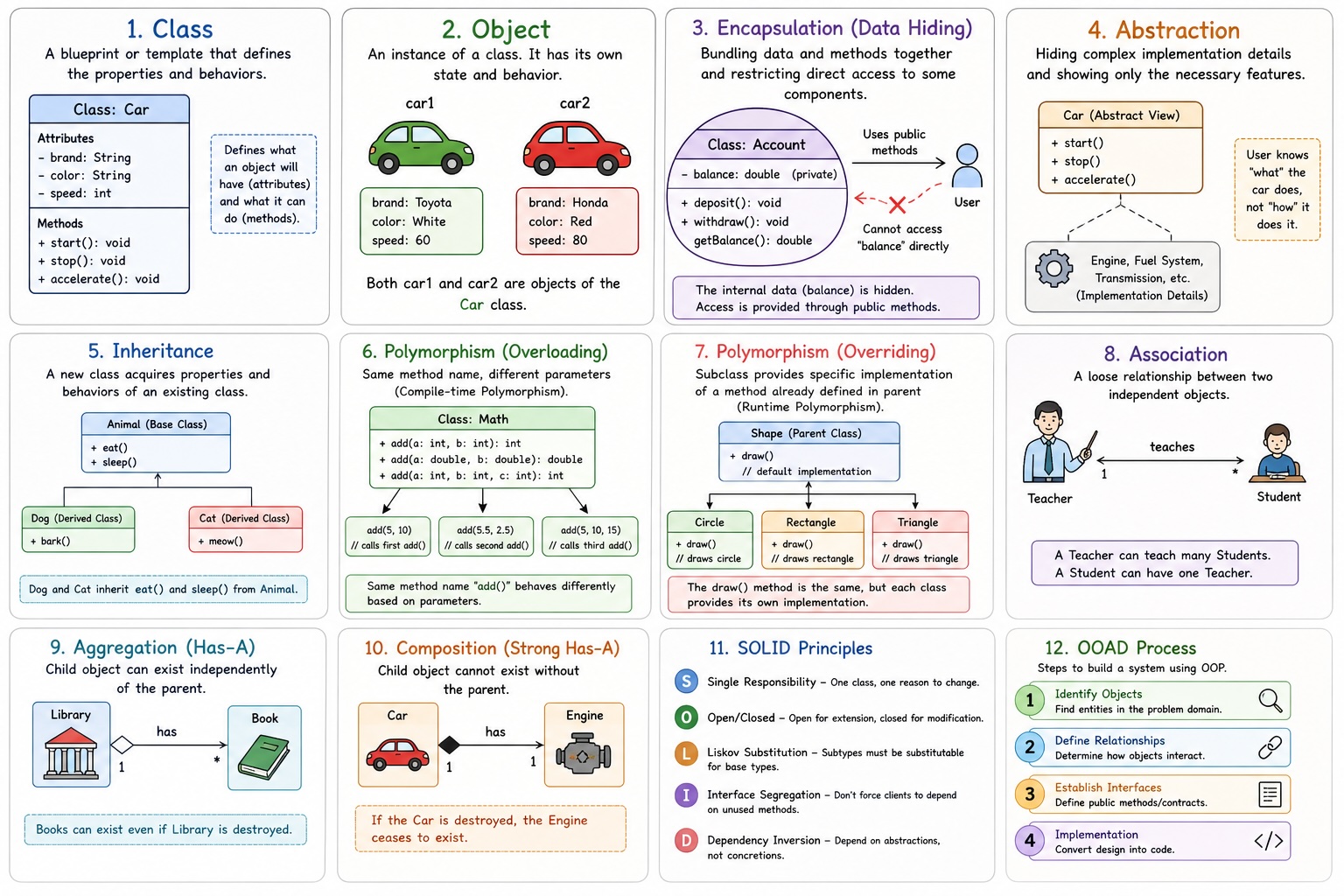
Object-Oriented Programming (OOP) is a programming paradigm based on the concept of "objects," which can contain data (attributes/properties) and code (methods/functions). Instead of focusing on logic and functions, OOP focuses on the data objects that developers want to manipulate.
1. Core Building Blocks
Class
A Class is a blueprint, prototype, or template that defines the variables and the methods common to all objects of a certain kind. It exists only in the source code; it does not occupy memory at runtime until it is instantiated.
Object
An Object is a self-contained unit of a system, an instance of a class. It represents a real-world entity (e.g., a specific "User" or a "Bank Account") and holds its own unique state.
2. The Four Pillars of OOP
To be considered truly object-oriented, a language or design must implement these four principles:
I. Encapsulation (Data Hiding)
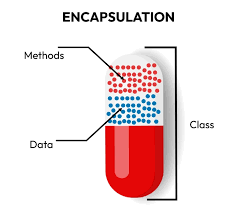
Encapsulation is the bundling of data and the methods that act on that data into a single unit (the class). It restricts direct access to some of an object's components, which is a vital way to prevent accidental state corruption.
- Mechanism: Achieved using Access Modifiers:
Private: Accessible only within the class.Protected: Accessible within the class and its subclasses.Public: Accessible from anywhere.
- Benefit: The internal "how-to" is hidden; users interact only through a public interface (Getters/Setters).
II. Abstraction
Abstraction is the process of hiding the complex implementation details and showing only the necessary features of an object. It reduces complexity by letting the programmer focus on what an object does instead of how it does it.
- Mechanism: Achieved through Interfaces and Abstract Classes.
- Analogy: You know that pressing the accelerator makes the car go faster, but you don't need to understand the internal combustion process to drive.
III. Inheritance
Inheritance is a mechanism where a new class (Subclass/Derived) acquires the properties and behaviors of an existing class (Superclass/Base).
- Relationship: It models an "Is-A" relationship (e.g., a "Dog" is a "Mammal").
- Benefit: Promotes Code Reusability.
- Modern Note: Favor Composition over Inheritance where possible to avoid rigid, deep hierarchies.
IV. Polymorphism
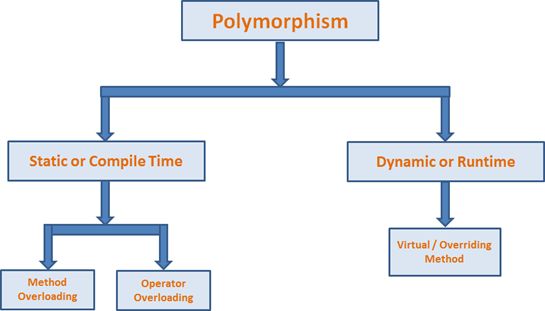
Polymorphism (meaning "many forms") allows objects of different classes to be treated as objects of a common superclass.
- Static (Compile-time) Polymorphism: Method Overloading (same method name, different parameters).
- Dynamic (Runtime) Polymorphism: Method Overriding (a subclass provides a specific implementation of a method already defined in its parent).
3. Object Relationships (Advanced Concepts)
Beyond the four pillars, modern OOP design requires understanding how objects relate:
- Association: A loose relationship between two independent objects (e.g., a Teacher and a Student).
- Aggregation: A "Has-A" relationship where the child can exist independently of the parent (e.g., a Library has Books; if the Library closes, the Books still exist).
- Composition: A strong "Has-A" relationship where the child cannot exist without the parent (e.g., a Human has a Heart; if the Human dies, the Heart ceases to function).
4. Modern Standard: The SOLID Principles
To create robust and maintainable software, current industry standards rely on the SOLID acronym:
- S - Single Responsibility: A class should have only one reason to change.
- O - Open/Closed: Software entities should be open for extension but closed for modification.
- L - Liskov Substitution: Subtypes must be substitutable for their base types.
- I - Interface Segregation: Clients shouldn't be forced to depend on methods they don't use.
- D - Dependency Inversion: Depend on abstractions, not concretions.
5. OOAD: Object-Oriented Analysis and Design
The process of building a system involves identifying objects and mapping their interactions:
- Identify Objects: Determine the entities within the system domain.
- Define Relationships: Determine how objects interact (Inheritance, Composition, etc.).
- Establish Interfaces: Define the public methods/contracts for each object.
- Implementation: Convert the design into executable code using an OO language (Java, C++, Python, C#, etc.).