Advanced Class Design & Robust Architecture
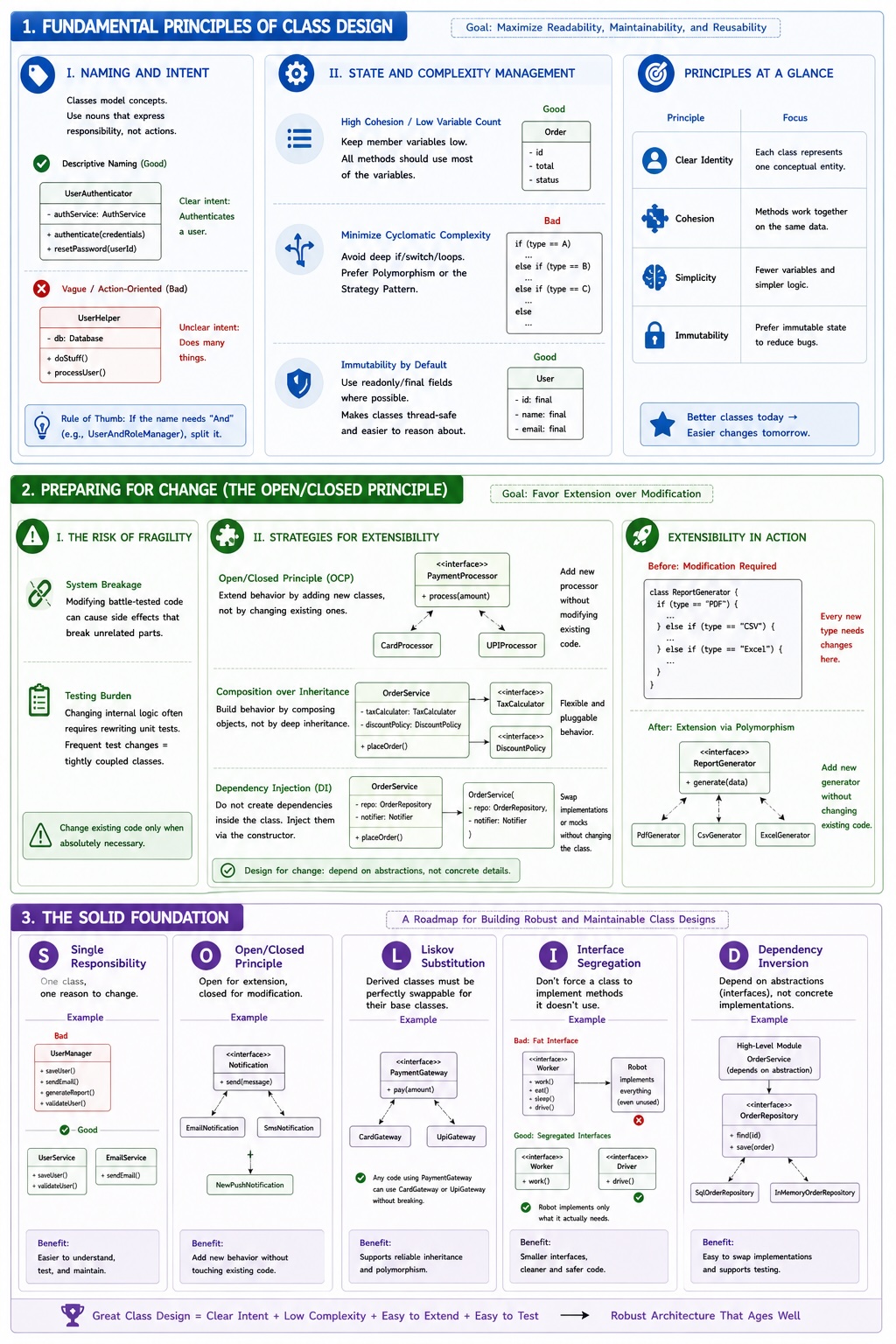
1. Fundamental Principles of Class Design
Class design principles are not rigid rules but heuristic guidelines aimed at maximizing readability, maintainability, and reusability.
I. Naming and Intent
- Descriptive Naming: Classes should be named using nouns that represent their responsibility (e.g.,
UserAuthenticatorinstead ofUserHelper). - The "Single Responsibility" Rule: A class should represent a single conceptual entity. If you struggle to name a class without using "And," it likely needs to be split.
II. State and Complexity Management
- High Cohesion / Low Variable Count: Keep the number of member variables low. If a class has too many variables, it is likely doing too much. Aim for high cohesion—where all methods in the class utilize most of the variables.
- Minimize Cyclomatic Complexity: Use few control structures (
if,switch,while).- Modern Standard: Prefer Polymorphism or the Strategy Pattern over deeply nested
if-elseorswitchblocks to handle behavioral variations.
- Modern Standard: Prefer Polymorphism or the Strategy Pattern over deeply nested
- Immutability by Default: In modern (2026) development, favor immutable state. Use
readonlyorfinalfields where possible. This makes the class thread-safe and easier to reason about.
2. Preparing for Change (The Open/Closed Principle)
Software is "soft" because it must change. However, change introduces risk. Great design focuses on Extension rather than Modification.
I. The Risk of Fragility
- System Breakage: Modifying existing, "battle-tested" code carries the risk of side effects that can break seemingly unrelated parts of the system.
- Testing Burden: Changing a class's internal logic often requires a total rewrite of its unit tests. If you find yourself frequently changing tests for existing features, your classes are likely too "tightly coupled."
II. Strategies for Extensibility
- Open/Closed Principle (OCP): Software entities should be open for extension but closed for modification. Use interfaces or abstract classes to allow new functionality to be added via new subclasses rather than changing the base code.
- Composition over Inheritance: Avoid deep inheritance trees. Use composition (holding instances of other classes) to build complex behavior. This makes the system more flexible and "pluggable."
- Dependency Injection (DI): Do not hard-code dependencies inside a class. Pass them in (inject them) via the constructor. This allows you to change behavior (or swap in "mocks" for testing) without touching the class's internal logic.